Standing at my stove, flipping crêpes for my kids, I wonder why they have garnered the reputation of elegant and poised, while the poor American pancake is relegated to delicious, but lowly brunch food. Is it simply the air that all French foods bring along with them? The sense that, because a country made most of the rules in restaurant kitchens for so long (and still largely does), their cuisine must be better. Je pas. (I don’t know).
As one who considers herself a pancake connoisseur, I am on an endless hunt for the perfect pancake recipe. We make pancakes every Friday at my house for Flapjack Friday, and more often than not, it is a new recipe instead of one of my standbys. Obviously I am a huge fan of pancakes.
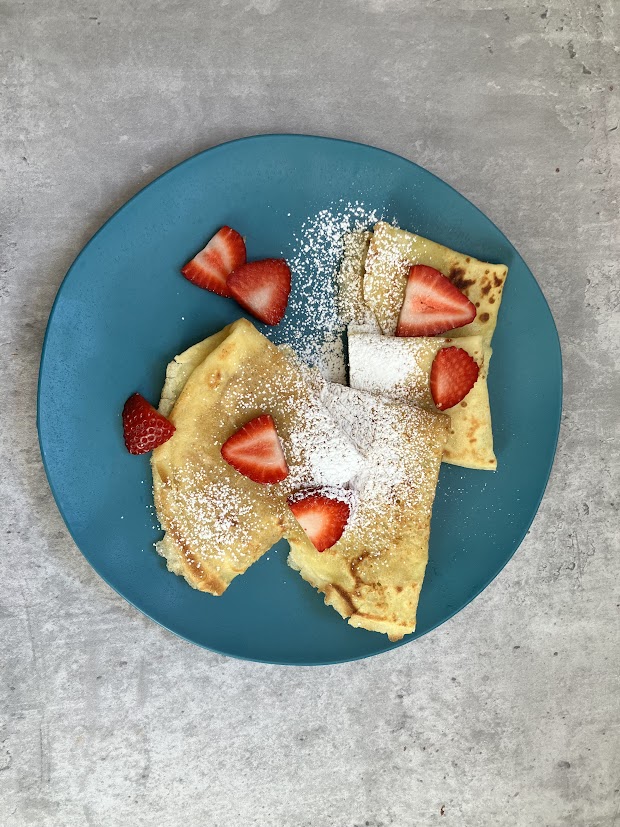
For me, the best part of crêpes is that you get to fill them. For kids, the ability to customize something is huge. Particularly for our friends that have a more limited palate. Making something your own makes them 1000x more likely to view that food positively. My kids range from nutella filled, to egg and cheese filled, with many variations in between.
The other added benefit of making crêpes at home with your kids is that they will realize something that is viewed as a specialty item only eaten at restaurants is actually quite easy (and cheap) to make at home. This mentality will add to their kitchen self esteem and reassure them that most dishes are not as scary as they seem.
In class this week we are making two versions of crêpes. This recipe is for a sweet crêpe, but you can also fill it with anything savory if you want. That will not make a big difference. The other crêpe we will make is a savory buckwheat crêpe. This one will be finished with ham, cheese, and egg.
Jaques Pépin is one of the most influential culinary teachers in the world, and has made French food more accessible to many American home kitchens. I particularly love his approach to crêpes. Every time I see or hear him explain them, my crêpe confidence is bolstered. Here is his demonstration of making crêpes two ways.
I highly recommend watching his pan swirling technique. This is the hardest part of making crêpes. The batter is simple, and, as Jaques says, the batter will be ready by the time your butter melts. Many people say you need to rest your crêpe batter overnight, including Julia Child, but as Jaques says “it does not look tired to me” so we make our batter fresh in class and cook it right then. Kenji at Serious Eats agrees.
If you like, use a blender to mix up all ingredients. We have the hand whisked version here, because I think it’s a more sensory pleasing way to do it with kids. No loud blender to send them running out of the kitchen, and they get to see the eggs and milk combining with the dry ingredients in a tornado of colors and textures.
Crêpes
Ingredients
Makes 6 crêpes
1 Tablespoon butter
⅓ cup flour
½ cup milk
1 egg
Pinch salt
½ teaspoon sugar
2 Tablespoons water, if needed
Instructions
- Melt your butter in a large skillet. *see note*
- Add flour, ¼ cup milk (only half of what we will use), 1 egg, a pinch of salt, and ½ teaspoon sugar to a medium bowl. Whisk quickly until the batter is very smooth and there are no more lumps. Add the other 1/4 cup of your milk and whisk again. Add your water and whisk again. Use a ladle to test pour some of your batter back into the bowl. The batter should flow like water, not any thicker.
- Pour melted butter into batter and whisk again to combine.
- Hold your hot skillet at a 45° angle and ladle half of a ladle into the pan. Quickly swirl your skillet in order to coat the whole pan in batter. If you have any holes, don’t worry! Just fill it in with a tiny scoop of batter and shake and swirl your pan to spread the batter.
- Cook your crêpe until the top side goes from looking shiny to not shiny. Use a rubber spatula to check that the bottom of your crêpe is speckled with light brown. Flip your crêpe and cook the other side for 30 seconds.
- Stack your crêpe on a large plate and repeat with remaining batter.
- Fill crêpe with jam, nutella, butter, sprinkle with powdered sugar, peanut butter, whipped cream, banana slices, strawberries, or endless other fillings.
Notes
- The best skillet for this recipe is a 10 inch non-stick skillet with a 7 inch bottom surface.
- Recipe adapted from Jaques Pépin
 truefamilyfood