Churros. The delightfully crispy on the outside and pillowy soft on the inside snack. Many cultures around the world have their version of fried dough. Fritter, cruller, doughnut, beignet, porra, youtiao, elephant’s ear, funnel cake, and buñuelo are just a few examples. There are also many different versions of churros across the globe.
Churros in Spain are much simpler in ingredients than churros in Mexico. Spanish churros are often just flour, water, and salt. They are dipped only in sugar. They are not usually filled, but are dipped in an unsweetened chocolate. Mexican churros often have eggs and butter in their batter, may be filled, and can be dipped in cinnamon sugar. Spanish shepherds would fry strips of dough to make a nice, portable snack to bring with them out into the mountains on their long journeys.
The shape of the pastry reminded the Spanish shepherds of the shape of the Navajo-Churro sheep’s horns. Food historians note that recipes in Apicius (a 1st-century Roman cookbook) for simple flour, water, and salt fritters are precursors to modern churros, showing ancient Mediterranean roots.
If you’ve ever had a churro at Costco, Disneyworld, or in Mexico, you’ll notice these are slightly different. Those versions tend to have eggs and butter in the batter making it more cake-like, while a Spanish churro is more simple. We are using just flour, baking powder, salt, and water in this recipe.
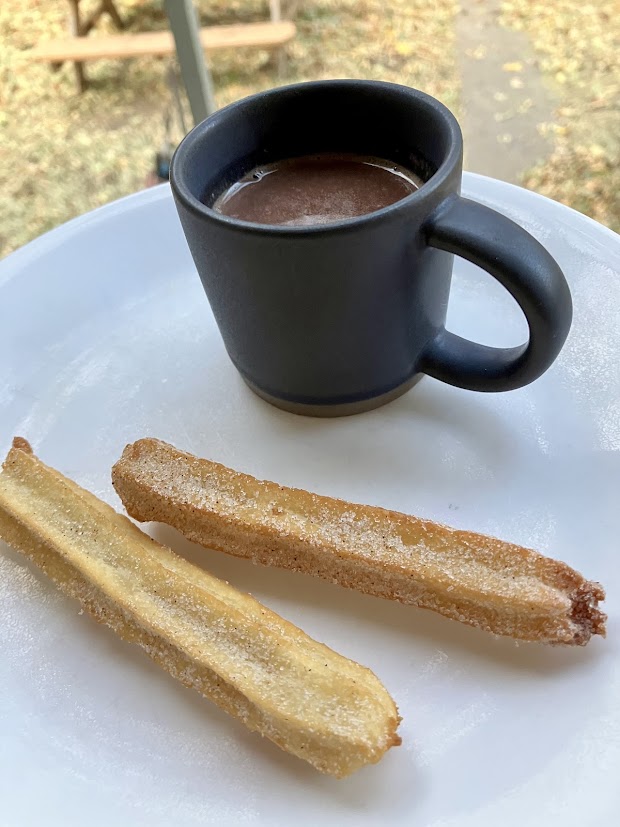
In Spain, churros are often eaten for breakfast with a nice mug of hot chocolate. They are often coated in sugar (not cinnamon sugar as is done in Mexico). The combination of fried dough, sugar, and chocolate is a winner in my book. Spanish churros are also not often filled, like their Latin American counterparts.
Deep frying can be done very safely, but it does pose many risks. I will give some tips and ideas that I think make it safer to have kids in the kitchen when frying, but ultimately you know your student and how much they are able to handle. Make sure you give age appropriate tasks. I would require students to be at least 8 years old with demonstrated kitchen experience and a calm attitude to be able to lower their own churro into the oil. Use your best judgement and err on the side of safety!
Spanish Churros
Ingredients
1 cup water
8 cups canola oil
1 cup flour
1 teaspoon baking powder
½ teaspoon salt
½ cup sugar
Instructions
- Boil water.
- Heat oil in a large, heavy bottomed pot over medium heat. You want it to stay around 350℉.
- Cut small rectangles of parchment paper about 6 inches long by 3 inches wide. You will pipe your churro dough onto these. You will need about 10 pieces.
- Place a few paper towels on a plate.
- Place a rack in a sheet pan (or use extra paper towels in a sheet pan or plate).
- Add your sugar to a wide, flat bowl for dipping the churros in later.
- Add flour, baking powder, and salt. Stir until flour is no longer dry. You can add up to 2 Tablespoons of water if it still looks dry.
- Add your dough to a churro press. Pipe your dough onto your small rectangles of parchment paper. Slide your dough and paper off the counter and directly onto a spider or slotted spatula or spoon that can withstand hot oil (not plastic).
- Ask a grown up for help and SLOWLY lower churro into hot oil. Give the churro a few seconds to cook, and then use metal tongs to remove the paper from the churro and place it on a paper towel lined plate. Make sure to keep your tongs pointed down to ensure that no hot oil runs up onto your hand.
- Fry three churros at a time, depending on the size of your pot. After 2 minutes, flip your churros over using your metal tongs or spider tool. Cook another 2 minutes or until lightly golden brown.
- Remove your churros using your tongs or spider tool and place on your wire rack. Once they have cooled enough to handle, add them to your bowl of sugar and toss to coat.
- Serve warm.
Notes
- A churro press is incredibly helpful for making these. You can also use a piping bag with a large star tip, but because the dough is so thick, it is difficult to squeeze out.
- You can also serve these with any melted chocolate you like to dip them in.
 truefamilyfood